Snowmobile Tour Operator Insurance: The Complete Guide
Running guided snowmobile tours is one of the most rewarding businesses in the outdoor economy — and one of the most exposed. You put paying guests, many of them first-time riders, on powerful machines in cold, remote, avalanche-prone terrain, and you do it for a living. That combination of motorized recreation, paying participants, and unforgiving winter conditions is exactly why a serious insurance program isn't optional for a tour operation.
This guide walks through every coverage a snowmobile tour or rental business needs, what drives the cost, how risk management and waivers fit in, and what land-use permits require. Whether you're launching your first season or reviewing an existing program, use it as a map to make sure nothing critical is left exposed.
Why Snowmobile Tour Operators Face Unique Risks
Most businesses carry one or two kinds of risk. A snowmobile tour operation stacks several on top of each other at once:
- Motorized recreation. Snowmobiles are fast, heavy machines. Crashes, rollovers, and collisions happen, and they cause real injuries.
- Paying participants. Your guests aren't spectators — they're actively operating or riding, which creates participant-injury exposure that ordinary liability policies often exclude.
- Cold and remote terrain. Injuries in the backcountry are more severe and harder to respond to. Cold injury, delayed evacuation, and difficult access compound everything.
- Avalanche exposure. Snowmobilers are now the single largest group of U.S. avalanche fatalities — about 23% of the total — and the most common factor in motorized avalanche accidents is a lack of advanced avalanche training.
- Seasonal, high-intensity operations. You earn your entire year in a few short months, which magnifies the damage any interruption can do.
No single insurance policy addresses all of that. A proper program layers several coverages so there are no gaps between them. Let's go through each.
General Liability: The Foundation Coverage
Commercial general liability (CGL) is the base layer of every tour operation's program. It responds to third-party bodily injury and property damage arising from your operations — a guest injured on a tour, a bystander struck near your staging area, or damage you cause to a leased building. Critically, it pays not just for damages but for the legal defense, which is frequently the larger cost.
General liability is also a business prerequisite, not just a safety net. Landowners, event venues, and land-management agencies all require proof of CGL — usually naming them as an additional insured — before you can operate. Without it, you have nowhere legal to run tours.
Professional Liability & Participant Legal Liability: The Guided-Instruction Gap
Here's the coverage gap that catches the most operators. A standard CGL policy handles "premises" claims, but it can limit or exclude two things a guided operation desperately needs covered: injuries to the participants in your activity, and claims arising from your professional guiding decisions.
Participant legal liability restores protection for bodily injury to the paying guests actively taking part in your tour — your single most likely serious claim. Professional liability (errors & omissions) covers allegations that your guiding service itself was negligent: poor route selection, an inadequate safety briefing, a bad terrain call. For a guided snowmobile operation, both are essential, because a plaintiff's attorney will frame a guest's injury as either a participant claim, a professional-negligence claim, or both.
Physical Damage & Inland Marine: Protecting Your Fleet
Liability coverage protects other people. Physical damage — usually written as inland marine for a snowmobile fleet — protects your own machines and gear. It pays to repair or replace sleds, trailers, helmets, GPS units, and safety equipment after collision, rollover, fire, theft, or vandalism.
The crucial detail is where your sleds operate. Personal snowmobile policies exclude commercial use entirely, and standard auto forms typically exclude off-road and backcountry operation — which is exactly where much of the riding happens. A properly written physical damage form covers your fleet on groomed trails, off them, in the backcountry, and in transit. You'll also choose between agreed-value settlement (a fixed payout you know in advance) and actual cash value (depreciated, cheaper premium), and decide whether to schedule each sled or blanket the fleet.
Rental Operations Coverage: The Extra Exposure of Handing Over the Throttle
The moment you rent a sled instead of guiding it, your risk changes fundamentally. A guided tour keeps a trained professional controlling the ride; a rental hands a powerful machine to someone who may never have ridden, then lets them leave your sight. Insurers rate guided and rental exposures very differently, and an operation that does both must insure each correctly.
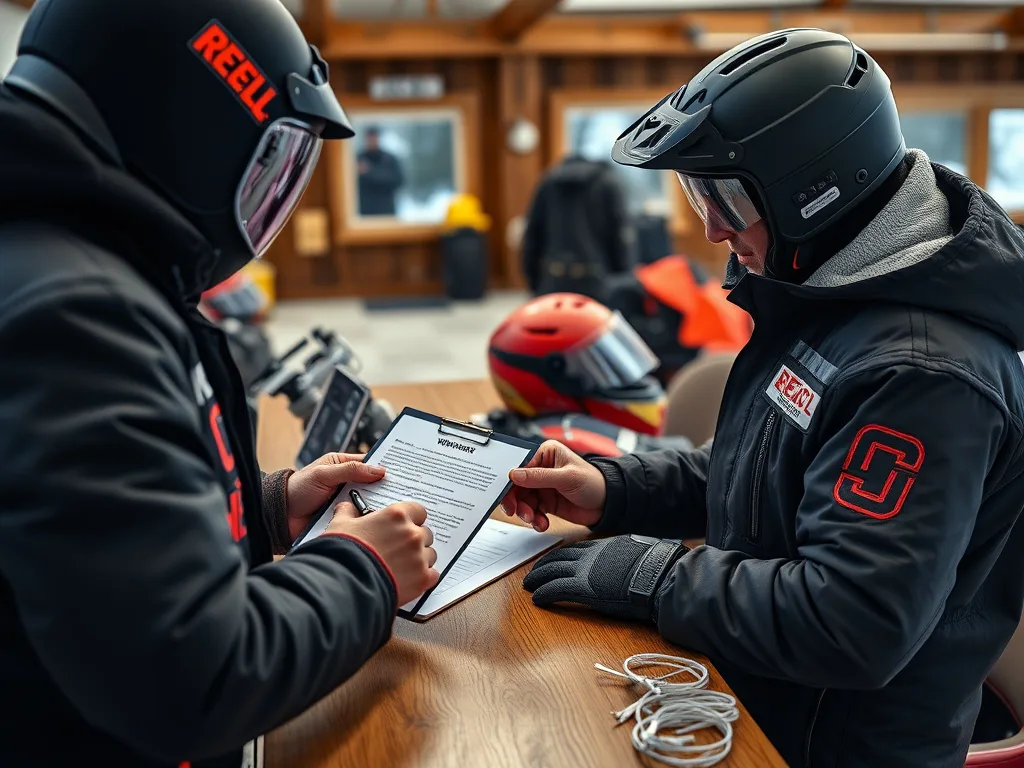
Rental programs need rental liability, physical damage limits sized for higher loss frequency, and often support for a collision-damage-waiver (CDW) program you offer customers. The biggest lever on rental risk is documented renter screening — verifying age and ID, capturing signed agreements and releases, and giving a real safety orientation. Carriers reward that discipline with better availability and pricing.
Commercial Auto & Trailer: Moving Guests and Machines
A large share of your exposure never touches the snow — it's on the highway. Trucks and vans shuttle guests, and enclosed trailers haul tens of thousands of dollars of sleds over winter roads. Commercial auto insurance covers the liability and physical damage for those vehicles and trailers in business use.
This is where a dangerous assumption bites operators: a personal auto policy excludes business use, and hauling paying guests or a commercial fleet is unambiguously business use. Carrying passengers for hire also raises your liability exposure sharply, so limits need to reflect that you transport guests. Each trailer should be scheduled, and coverage should coordinate with the sleds' physical damage form so there's no gap between "on the trailer" and "off the trailer."
Workers Compensation: Covering Seasonal Guides and Staff
Guiding is physical, cold-weather, motorized work in remote places, and your guides, mechanics, and trail hands get hurt on the job. Workers compensation pays their medical bills and lost wages regardless of fault, and its employer's liability component responds if an injured worker sues.
In most states, workers comp is legally required the moment you have employees, no matter how short your season. Two traps snare seasonal operators: assuming a short season exempts you (it usually doesn't), and misclassifying guides as 1099 contractors to dodge the requirement (states reclassify workers based on how the work is actually controlled). Premium is driven by payroll, so a short season is reflected in the cost — often trued up at audit.
Commercial Property & Business Income: Protecting the Lodge and the Season
Commercial property coverage protects your base — the lodge, shop, staging garage, tools, and parts inventory — against fire, winter weather, theft, and vandalism. But for a seasonal operation, the most devastating property loss is often the revenue you lose while you can't operate.
Business income (business interruption) coverage replaces lost net revenue and helps pay continuing expenses while you recover from a covered loss. Because a snowmobile business earns its entire year in a few winter months, a shop fire in December can cost far more in canceled tours than in burned equipment. Size this coverage to your peak-season earnings, not a flat annual average, and value buildings and key equipment at replacement cost so a total loss actually rebuilds what you had.
What Drives Your Premium
There's no flat rate for snowmobile tour insurance, because no two operations carry the same risk. The main cost factors are:
- Annual revenue and guest volume — more tours and more guests mean more exposure.
- Guided vs. rental mix — rental operations rate higher because you lose control of the machine.
- Fleet size and value — more sleds, and more valuable ones, cost more to insure.
- Terrain — groomed-trail operations rate lower than backcountry and avalanche terrain.
- Payroll — drives your workers comp premium.
- Claims history — a clean loss record lowers cost; prior claims raise it.
- Limits requested — higher liability limits and umbrella layers add premium.
The single best way to get an accurate number is to request a quote with real details about your operation.
Risk Management That Lowers Premiums
Insurance transfers the cost of a loss; risk management reduces how often losses happen — and carriers reward it with better coverage and pricing. The highest-leverage controls for a snowmobile operation are documented guide training and certification, avalanche education and go/no-go protocols, sled maintenance logs, enforceable participant waivers, and clear incident-response procedures.
Avalanche training deserves special emphasis. Because snowmobilers are the largest group of U.S. avalanche fatalities and lack of advanced training is the most common accident factor, documented avalanche education is one of the strongest signals you can send an underwriter — and sometimes the difference between coverage being available for your backcountry operation or not.
Waivers vs. Insurance: What an Enforceable Release Can and Can't Do
Many operators believe a signed waiver ends their liability. It doesn't. A well-drafted participant release — written to your operating states, clearly communicating the inherent risks, and signed by an adult before the activity — can deter claims and give you a defense. That's genuinely valuable.
But a waiver never replaces insurance. Enforceability varies dramatically by state; some states (such as Virginia) refuse to honor pre-injury releases at all. And no waiver anywhere bars a claim of gross negligence, recklessness, or intentional conduct — precisely the allegations plaintiffs raise. Treat your waiver as one layer of defense that makes your insurance more effective, not as a substitute for it.
Permits, Additional Insureds & Certificates of Insurance
If you operate on public land, insurance is a permit requirement. USFS and BLM outfitter-guide special-use permits typically require:
- General liability at limits set by the permit administrator (risk-based).
- The U.S. Government named as an additional insured in specific, verbatim language.
- A 30-day cancellation-notice provision in the policy.
- A certificate of insurance filed before the permit is issued and again each year it's active.
Landowners and event venues have their own additional-insured and certificate requirements. A program built for tour operators handles this wording precisely and issues the certificates and endorsements your permits and partners demand — because getting a single word wrong can hold up your permit.
Umbrella & Excess Liability: When Base Limits Aren't Enough
A standard $1M/$2M general liability limit sounds like a lot until a single serious injury claim blows through it. A guest with a spinal injury from a backcountry crash can generate medical costs, lost-earnings claims, and legal exposure that dwarf a base policy limit — and once the underlying limit is exhausted, the rest comes out of your business.
Umbrella (or excess) liability sits on top of your general liability, auto, and employer's liability, adding a layer of protection — often $1M, $5M, or more — that kicks in when an underlying policy is exhausted. For many tour operators it's not a luxury: permits, land managers, and larger venues increasingly require higher combined limits than a base policy provides, and an umbrella is the efficient way to reach them. It's also one of the more cost-effective coverages dollar-for-dollar, because it only pays after the primary limits are gone.
We help you right-size the umbrella to your actual exposure and to the specific limit requirements in your permits and contracts, so you're compliant without overpaying for limits you'll never need.
Insuring Multi-State and Cross-Border Operations
Plenty of snowmobile operators run trips in more than one state — chasing snow across the Rockies, or operating on both sides of a state line. That flexibility creates an insurance wrinkle, because requirements don't stop at the border. Workers compensation rules, minimum liability limits, and permit terms all vary state to state, and a policy written for one state may leave you exposed in another.
Multi-state operations need coverage that contemplates every state you operate in: workers comp that satisfies each state's mandate, liability limits that meet the highest requirement among your permits, and physical damage and auto coverage that follow your sleds and trailers wherever they travel. Getting this right up front avoids the nightmare scenario of a claim in a state your policy didn't properly cover.
If you're expanding into new terrain or new states, tell us early. It's far easier to build the coverage before the season than to discover a gap after a claim.
The Most Common Coverage Mistakes Operators Make
Over and over, the same avoidable gaps show up when operators shop for or review their coverage. Knowing them is half the battle:
- Relying on a personal snowmobile policy. It excludes commercial and for-hire use — every claim from your operation would be denied. This is the single most dangerous mistake.
- Assuming a generic policy covers participant injuries. Standard general liability can exclude the participants in your activity, leaving your most likely claim uncovered without a participant legal liability endorsement.
- Insuring a rental operation as if it were guided. Rentals carry a distinct, higher-rated exposure; a guided-only policy can leave your rental side underinsured or excluded.
- Ignoring backcountry exclusions. Many physical damage and liability forms quietly exclude off-trail operation — exactly where the riding happens.
- Treating a waiver as insurance. A waiver is a risk-management tool, not a coverage; it pays no defense costs and bars no gross-negligence claim.
- Getting the permit wording wrong. An additional-insured endorsement with the wrong language, or a missing cancellation-notice provision, can hold up your USFS/BLM permit right as the season starts.
A program built specifically for snowmobile tour operators is designed to close every one of these gaps — which is exactly why the niche specialization matters.
How to Get Covered: What to Gather Before You Request a Quote
To get an accurate quote quickly, pull together: your business type (guided, rental, or both), annual revenue and guest counts, fleet size and sled values, the states and terrain you operate in, your payroll and staffing, your claims history, and any permit or venue insurance requirements you have to meet.
With those details, a specialist can build a program that fits your real exposure — with no gaps between coverages and the certificates your permits require.
Protect Your Operation
Snowmobile tour operator insurance isn't a single policy — it's a coordinated program of general and participant liability, professional liability, physical damage, commercial auto, workers comp, and property, tuned to how you actually operate. Insured piecemeal, gaps open up. Insured as a program, the pieces interlock.
Tell us about your operation and we'll build it around your real risk. Request a quote or call 844-967-5247 to protect your season.
Frequently Asked Questions
What is the most important coverage for a snowmobile tour operator? General liability with participant legal liability is the foundation — it responds to the guest injuries that are your most likely claim and satisfies the requirements of landowners, venues, and permits. But no single coverage is enough on its own; guided operations also need professional liability, and every operation needs physical damage, auto, workers comp, and property to avoid gaps.
Can I get coverage if I operate in avalanche terrain? Yes, though carriers scrutinize backcountry operations closely. Documented avalanche training and certification, go/no-go protocols, and safety procedures are what make coverage available and affordable — because lack of advanced avalanche training is the leading factor in motorized avalanche accidents.
How fast can I get a certificate of insurance for a permit? Once your policy is bound, we can issue certificates of insurance and additional-insured endorsements — including the verbatim USFS/BLM wording — quickly, so an insurance technicality never delays your permit or your season.
Ready to protect your operation?
Tell us how you operate and we'll build coverage around your real exposure.